.webp)
Used Tractor Valuation Research: What Purdue's Data Study Means for Equipment Dealers

Tractor Zoom partnered with Purdue University to do something the industry rarely does: Statistically test and apply numbers to what dealers have been experiencing for decades.
Equipment dealers have good instincts. After years on the lot, in the auction lanes, and on the phone with lenders, most equipment professionals develop a working mental model of what drives used tractor values. Hours. Age. Brand. Time of year. Auction type. The factors are not a mystery to those who’ve been in the industry for years.
So when Tractor Zoom's Director of Insights, Andy Campbell, partnered with agricultural economists at Purdue University to run a formal statistical study of used tractor auction prices, the findings provided good affirmation to our dealers’ current practices.. Analysis like this, while directionally obvious to veterans in our industry, is crucial to taking the next step of data transformation and future use of AI.
How dealers’ gut feeling becomes ground truth
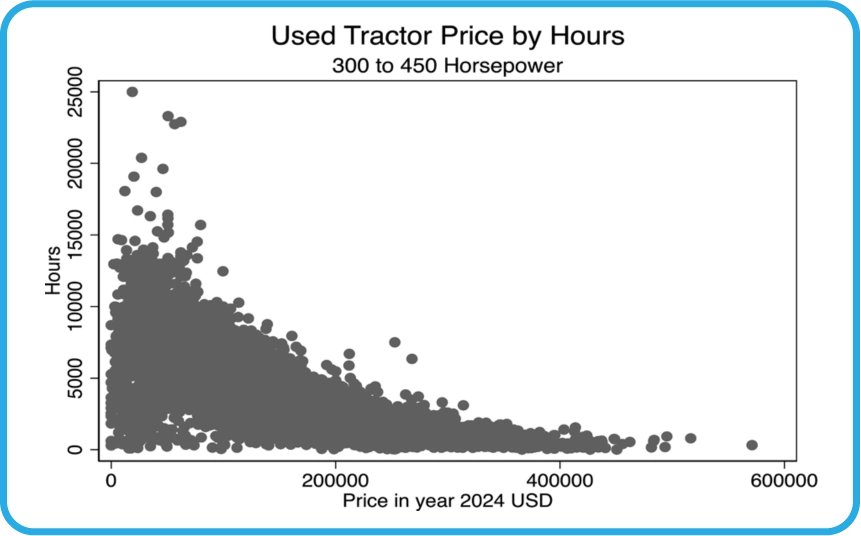
The study, titled “A Hedonic Analysis of Farm Tractor Auction Prices,” was published in May 2026 in the Agricultural and Resource Economics Review by Cambridge University Press. It analyzed 6,821 individual U.S. auction observations of 300 - 450 HP tractor sales spanning from 2006 to 2024. Using a hedonic regression model, researchers isolated the specific price contribution of dozens of machine and market characteristics simultaneously: Usage hours, age, horsepower, drivetrain, brand, auction type, and month of sale.
The data source was Tractor Zoom's proprietary auction database, which is one of the largest and most detailed collections of farm equipment transaction data in the country.
What the researchers found confirmed a non-linear hourly depreciation curve, brand premiums are real, retirement auctions command a premium, and January is a better time to sell than June.
But the paper puts precise, dollar figures on each of these dynamics, and it does so with an R² of 0.902, which means the model explains over 90% of the variation in price for this dataset. That's an exceptionally strong fit for this type of analysis, comparable to or better than any prior published study in this space.
For dealers, their instinct is validated. For anyone building pricing tools or models on top of that instinct, this validation is the foundation to a successful operation.
Why equipment data quality is the real story
A key point that’s easy to miss in looking at this study is that the researchers weren't just testing “economic theory.” They were stress-testing an actual dataset.
"The breadth and depth of the data surprises a lot in academia," Campbell notes. "They're usually searching and scraping secondary data sources that are incomplete or very patchwork."
Researchers studying farm machinery have historically worked with fragmented or dated records. Tractor Zoom's database provides something much more robust with a large, current, and standardized set of real-world transactions with detailed machine characteristics attached to every sale. The result is a proof point that the data is extremely high quality. Enough to confidently anchor serious quantitative work.
This is the bridge between the data that dealers generate every day and the analytical rigor needed to turn that data into reliable insight, and this is often underutilized in the equipment industry. Applying good data is about capturing the full lifecycle, not just keeping a lot of records. This means:
- Collecting it consistently and at scale
- Storing it in a structured, accessible way
- Maintaining it so it stays current and accurate
- Understanding what it actually measures
- Making it actionable by connecting it to real decisions
The Purdue study is evidence that when you invest in that full chain, the data holds up under serious scrutiny.
The data-to-AI pipeline is not optional
There's a reason this research matters beyond academic recognition. It has everything to do with where the industry is heading.
Building a reliable AI pricing model isn't a leap you can make from intuition alone, or build in just a few weeks. It requires a foundation of clean, structured, current data; validated methods for understanding which variables drive value; and enough observations to distinguish signal from noise. The hedonic model at the center of this study is the same methodological family used in many modern price prediction engines.
"This type of research is pivotal to understanding what factors influence equipment valuation," Campbell notes. "If you ever want to build an AI price prediction model, you have to truly understand equipment, constant stream of equipment data and then have the learning process set up for continuous improvement.
For dealerships, this is a critical inflection point. The industry is moving faster toward AI-assisted pricing, sales workflow, and inventory management.
The research also highlights something Campbell has emphasized with Tractor Zoom's own customers in his regular ag equipment market reports: Data gets stale. This means models trained on conditions from five (or even two) years ago will not accurately reflect today's market. Staying current is what separates a useful valuation from a guess dressed up in math.
The value of industry and academia working together
This study also reveals a partnership model that the industry should pursue more deliberately. Tractor Zoom brought proprietary data and real-world practitioner expertise. Purdue brought methodological rigor, academic credibility, and the kind of external validation that no internal analysis can fully provide.
The result of this collaboration is peer-reviewed, published research that advances the industry's collective understanding of machinery valuation and carries the credibility of a leading agricultural economics institution.
Both Purdue and Tractor Zoom see this as a model worth replicating.
At Tractor Zoom we believe this association is meaningful because it’s a signal of the quality of the underlying infrastructure — the data, the methodology, and our team’s commitment to getting valuation right.
Now it’s time to put the data to work for your operations
Understanding what drives equipment value is foundational. But ultimately, it only matters if it improves the decisions you make every day, like how you appraise a trade-in, how you price aging inventory, when you move equipment.
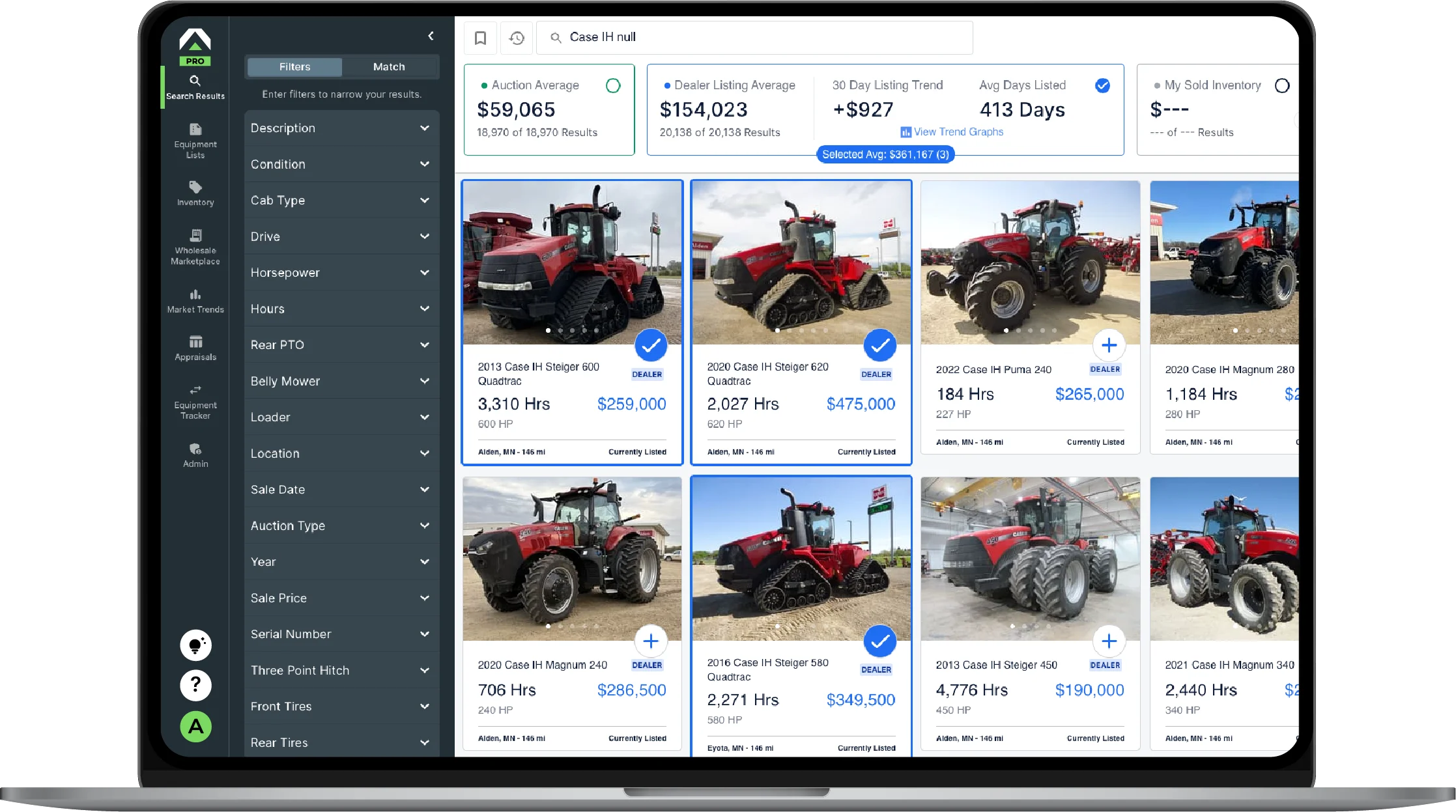
Tractor Zoom Pro and Anvil Pro are built on the same data that powered this research — current, structured, and continuously updated. Whether you're benchmarking a specific unit against comparable sales or looking for AI-assisted tools to streamline your appraisal workflow, the data behind the tool is what makes it trustworthy.
[Explore Tractor Zoom Pro] | [Learn more about Anvil Pro]
The full study ("A Hedonic Analysis of Farm Tractor Auction Prices" by Madison Pearson, Chad Michael Fiechter, and Andy Campbell) is published open access in the Agricultural and Resource Economics Review.

Join the future of ag & heavy equipment sales
Take a guided tour of Tractor Zoom Pro and Anvil Pro to discover how wider margins and faster turns are just a few clicks away.