
.webp)
Dealer Playbook: How Taking Action in a Down Market Creates Outsized Advantage
.webp)
The equipment downturn that started in mid-2023 has now stretched past the three-year mark, well beyond a typical correction cycle. And for many dealerships, the cash reserves built up during the boom years are gone.
So what separates the dealers who come out of this cycle stronger from the ones still playing catch-up when the market turns?
We sat down with Marc Johnson, CPA and Principal & Lead Advisor at Pinion Global, to build a practical decision framework for dealership leaders. Marc works with roughly forty dealerships nationwide and has seen a clear pattern emerge over the past two years: The dealers who acted early didn't end up in an immediately better financial position than those who waited, but they had far more control over how they got there. The dealers who merely reacted to circumstances had their pain chosen for them. You can find that full conversation in the video below:
This dealer playbook dives into the details of this discussion, unpacking these patterns and giving you the steps and tools needed to act on it.

What's inside:
- The real metric that matters right now. Some dealers posted record losses in 2025 but were fine on cash. Others had decent P&Ls but were bleeding cash without realizing it. Marc explains exactly why — and how to tell which camp you're in.
- A three-bucket inventory triage framework. Not all inventory deserves the same strategy. The playbook breaks your lot into three categories: Cash Conversion, Margin Protection, and System Fuel. Each includes a specific financial objective you can implement this month.
- Recalibrated KPIs for the current market. If you're still benchmarking against 2021–2023 performance, you're measuring against a mirage. Marc lays out seven specific metrics with current-cycle targets, from used production rate to aftermarket absorption, and explains why 2019 is the baseline year to measure by.
- The margin erosion most dealers aren't seeing. The biggest margin losses of the past two years didn't happen in whole goods. They happened in parts and service – the departments that actually make dealerships profitable. During the boom, whole goods dominated the sales mix so heavily that aftermarket underperformance was invisible. This is no longer the case.
- An analysis framework for dealership ROE. Profitability, asset turnover, and financial leverage, broken down in practical terms for equipment dealers, including why paying off all your lines of credit during the boom may not have been as prudent as it felt.
The bottom line
The strategies in this playbook aren't new. Most dealers know they should be triaging inventory, holding margin floors, and tracking KPIs more rigorously. The real question is whether your current tools and processes let you execute at the speed and scale the market demands — or whether you're relying on spreadsheets, memory, and good intentions.
Manufacturer production is near its floor. Commodity prices are stabilizing. The signals point toward an inflection in the next 12–18 months. The dealers who capture disproportionate market share when the cycle turns will be the ones who used this period to reset.

Join the future of ag & heavy equipment sales
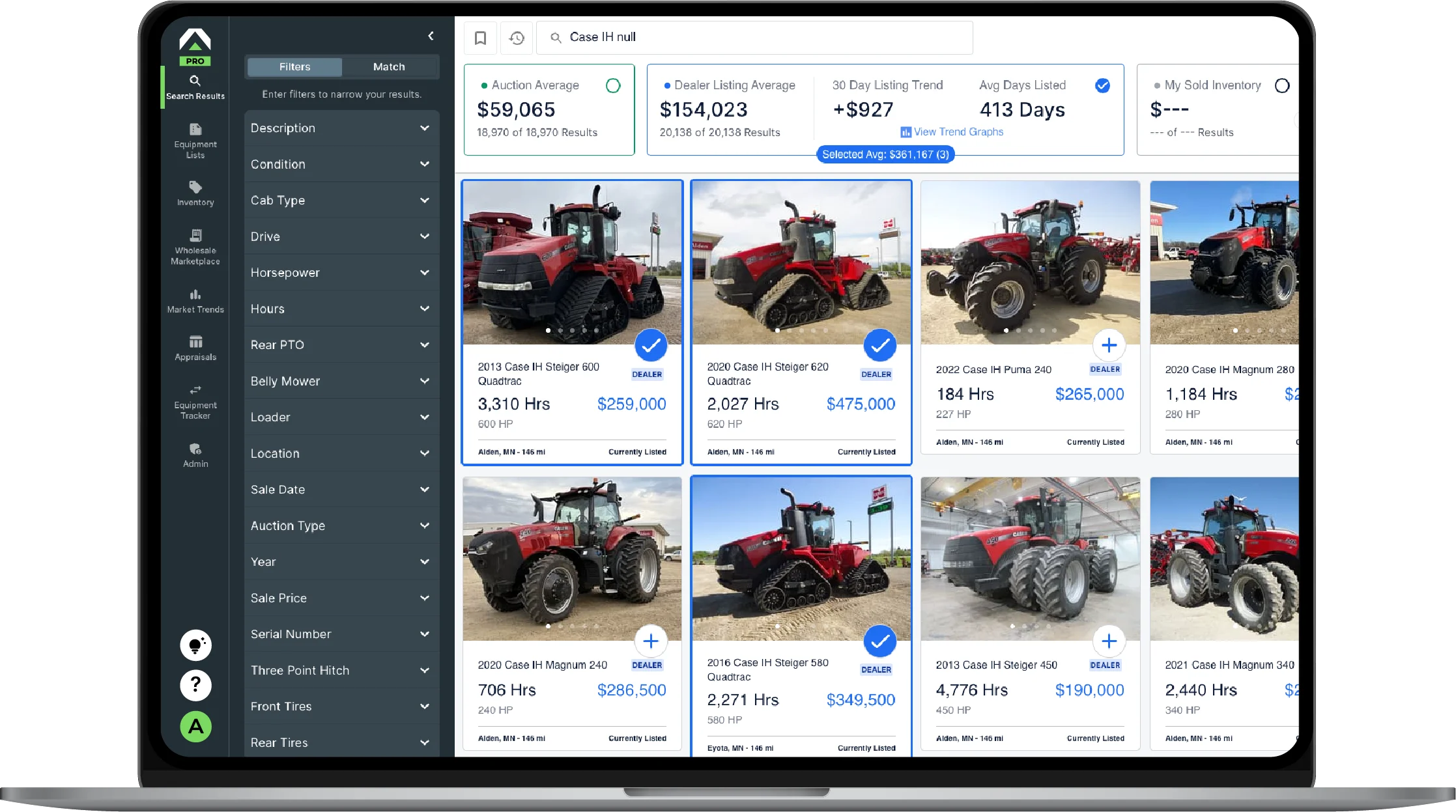
Take a guided tour of Tractor Zoom Pro and Anvil Pro to discover how wider margins and faster turns are just a few clicks away.